Interior Design Material Cost in Patna: Plywood, Laminates, Veneers & Hardware Guide
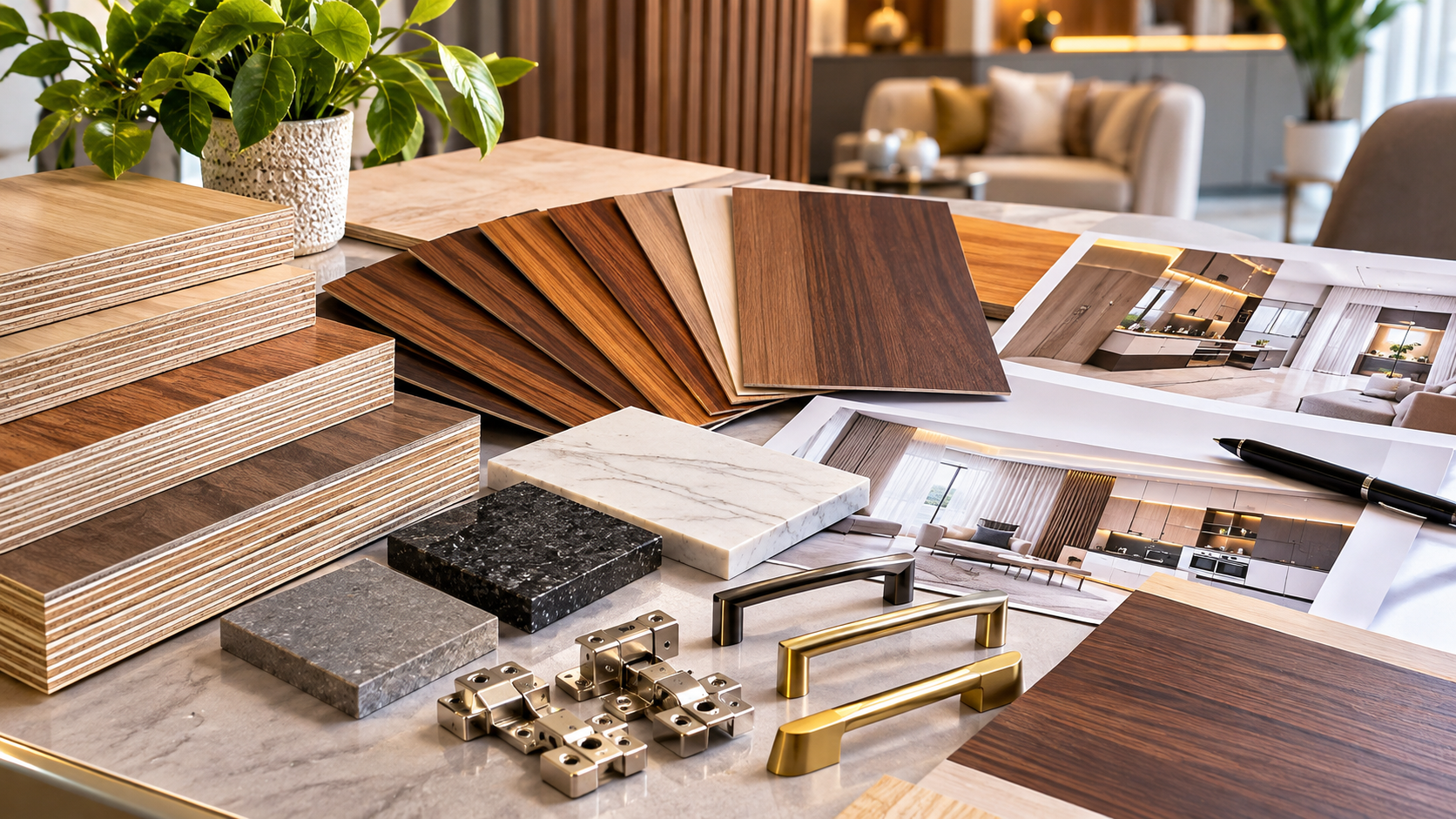
Planning your home interiors involves hundreds of decisions, but choosing the right materials is one of the most important. Plywood, laminates, veneers, hardware, countertops and decorative finishes influence not only the appearance of your home but also its durability, maintenance requirements and overall interior budget.
Many homeowners in Patna face a common challenge: two interior quotations may look similar, yet their prices can differ significantly. The reason often lies in the materials, specifications, hardware and finishing quality included in each proposal. Understanding Interior Design Material Cost in Patna can help you make informed decisions before starting your project.
Whether you are planning a modular kitchen, bedroom wardrobe, living room furniture or complete home interiors, this guide explains the major material categories, their cost factors and how to plan your budget effectively.
Why Does Material Selection Affect Interior Design Cost?
Materials are among the major factors influencing the overall cost of an interior project. However, selecting the most expensive material does not automatically guarantee the best result. The right choice depends on where the material will be used, how frequently the area will be used and what level of durability is required.
For example, kitchen cabinets need suitable resistance to moisture and everyday use, while bedroom wardrobes require stable boards, reliable hardware and durable finishes. Living room furniture may need a balance of appearance, strength and easy maintenance, whereas bathroom storage requires careful consideration of moisture exposure.
A well-planned material budget allocates spending according to actual usage rather than applying the same specification throughout the home. Decor ID helps homeowners compare materials, finishes and hardware according to their design preferences, space requirements and available budget through its professional material selection service.
7 Major Interior Design Materials and Their Cost Factors
Understanding different materials makes it easier to compare quotations and avoid unnecessary spending. Each material has different characteristics, applications and pricing factors, so the selection should always match the intended use.
1. Plywood: The Foundation of Furniture and Cabinets
Plywood is widely used in interior furniture, wardrobes, kitchen cabinets and storage units. Its cost depends on factors such as grade, thickness, construction, brand and quality.
Common categories include:
- MR plywood: Moisture-resistant plywood generally considered for suitable interior applications in relatively dry areas.
- BWR plywood: Boiling-water-resistant plywood that may be considered for applications requiring greater moisture resistance.
- BWP plywood: Boiling-water-proof plywood, commonly considered for demanding moisture-exposure applications when the product specification is suitable.
- Marine plywood: A specialised plywood category manufactured to meet its applicable standard and performance requirements.
The right specification should be selected according to the application rather than assuming that one grade is necessary for every furniture unit. For example, kitchen cabinets near sinks may require a more suitable moisture-resistant specification than a wardrobe installed in a dry bedroom.
What affects plywood cost?
- Grade and manufacturing quality.
- Board thickness.
- Brand and product specification.
- Surface quality.
- Certification and applicable standards.
- Supplier and availability.
The Bureau of Indian Standards identifies IS 303:2024 for plywood for general purposes and IS 710:2024 for marine plywood. Buyers should check the applicable product specification and current certification rather than relying only on a seller’s verbal description. Read the BIS information on plywood standards and certification.
2. Laminates: A Practical Surface Finish
Laminates are popular for kitchen shutters, wardrobes, cabinets, tables and other furniture surfaces. They are available in different colours, textures, patterns and finishes, making them suitable for a wide range of interior styles.
Common laminate finishes include:
- Matte laminates.
- Glossy laminates.
- Textured laminates.
- Wood-grain laminates.
- Stone-inspired finishes.
- Decorative and premium laminates.
The price depends on thickness, surface quality, design collection, brand, finish and sheet specifications. A standard laminate may be sufficient for a simple wardrobe, while a premium textured or decorative finish may be more suitable for selected feature areas.
One effective budgeting approach is to use premium finishes on visible focal points and practical finishes on less prominent surfaces.
3. Veneer: Natural Wood Appearance
Veneer is a thin layer of natural wood applied to a suitable substrate to create an authentic wood appearance. It is often selected for premium wardrobes, wall panels, furniture, doors and decorative surfaces. Unlike printed wood-grain finishes, natural veneer displays variations in grain and colour.
What affects veneer cost?
- Wood species.
- Veneer thickness and quality.
- Grain pattern.
- Sheet size and availability.
- Substrate preparation.
- Polishing and finishing requirements.
- Installation workmanship.
Veneer generally requires careful finishing and maintenance. Therefore, its overall cost should include the substrate, adhesive, application, edge treatment and final polish—not just the veneer sheet.
For homeowners who prefer a natural wood appearance but have a controlled budget, veneer can be reserved for selected furniture or feature surfaces rather than used throughout the home.
4. MDF, HDHMR and Other Engineered Boards
Engineered boards are used in furniture, decorative panels, cabinet shutters and customised interior elements. Different board types offer different characteristics and applications.
| Material | General characteristics | Common applications |
|---|---|---|
| MDF | Smooth and suitable for shaped or painted surfaces | Decorative panels, selected furniture |
| HDHMR | High-density board designed for improved moisture resistance compared with standard MDF | Selected shutters, cabinets and furniture |
| Particle board | Manufactured from wood particles and binders | Suitable budget-oriented furniture applications |
| Plywood | Layered wood construction with different grades and specifications | Cabinets, wardrobes and furniture |
The most suitable option depends on the product specification, expected load, moisture exposure, installation method and intended use. A lower-priced board may be appropriate for one application but unsuitable for another. For example, a board selected for a decorative bedroom panel should not automatically be specified for a moisture-exposed kitchen area.
5. Hardware and Furniture Fittings
Hardware may appear to be a small part of an interior project, but it has a significant impact on everyday usability. Common hardware includes hinges, drawer channels, soft-close systems, handles, knobs, wardrobe accessories, pull-out baskets, lift-up mechanisms and sliding door fittings.
The cost depends on the brand, material, load capacity, opening mechanism, finish and warranty. For example, a wardrobe with standard hinges and a wardrobe with premium soft-close fittings will have different hardware costs. Similarly, a modular kitchen with multiple pull-outs and corner mechanisms may require a higher hardware budget than a basic cabinet arrangement.
Budget tip: Prioritise reliable hardware for frequently used drawers, kitchen cabinets and wardrobes. Decorative handles and specialised accessories can be selected according to the overall design budget.
6. Countertops and Surface Materials
Countertops are important in kitchens, bathrooms and selected furniture units. Common options include granite, quartz, marble and solid-surface materials, each offering different appearance and maintenance characteristics.
- Granite: A natural stone frequently used for kitchen countertops. Its colour, thickness, finish and source influence the cost.
- Quartz: An engineered surface available in different colours and patterns. Product quality and design selection influence pricing.
- Marble: Offers distinctive natural patterns and a premium appearance, but requires consideration of staining, scratching and maintenance.
- Solid-surface materials: Used for selected countertops and integrated surface applications, depending on the product specification.
When comparing countertop quotations, consider the material, thickness, edge profile, cut-outs, installation and finishing. The cheapest surface may not be the best choice if it does not suit the intended use or maintenance expectations.
7. Paint, Wall Panels and Decorative Finishes
Decorative finishes help create the overall visual identity of an interior. Popular options include interior emulsion paint, textured wall finishes, decorative laminates, veneer wall panels, wallpaper, decorative mouldings, fluted panels and selected stone and tile finishes.
The overall cost depends on the material, surface preparation, design complexity, coverage area and installation labour. A feature wall can create a strong visual impact without applying premium decorative finishes to every wall.
For example, a living room may use a carefully designed TV backdrop with simpler surrounding wall finishes. This creates visual interest while keeping the material budget under control.
Room-Wise Interior Material Budget Planning
The same material specification is not necessary for every room. Each space has different functional requirements, exposure conditions and design priorities. Understanding these differences helps homeowners allocate their budgets more effectively.
| Room | Important materials | Budget priority |
|---|---|---|
| Modular kitchen | Plywood or suitable boards, laminates, hardware, countertop | Moisture suitability, durability and hardware |
| Bedroom | Wardrobe boards, laminates, hinges, drawer channels | Storage, finish quality and daily usability |
| Living room | Furniture boards, veneers, laminates, wall panels | Appearance, durability and design coordination |
| Bathroom | Suitable moisture-resistant materials, tiles and fittings | Moisture management and easy maintenance |
| Dining area | Furniture materials, tabletop surfaces and finishes | Strength, cleaning and appearance |
| Study room | Boards, laminates, drawer fittings and shelves | Functionality and storage |
Kitchen Material Budget
Kitchens experience frequent use, moisture exposure, heat, oil and cleaning. Therefore, material selection should focus on suitable cabinet construction, edge sealing, practical shutter finishes and reliable hardware.
Decor ID’s modular kitchen design guide for Patna explains how layout, cabinet materials, finishes and accessories influence kitchen functionality and cost.
Bedroom Material Budget
Bedroom interiors commonly include wardrobes, storage units, beds, side tables and decorative panels. You can control costs by choosing durable cabinet construction, practical laminate finishes and reliable fittings without unnecessarily upgrading every visible surface.
Living Room Material Budget
Living rooms often contain TV units, display shelves, furniture, wall panels and decorative elements. Instead of using expensive materials throughout the space, consider investing in selected focal areas and balancing them with simpler finishes. This approach can create a premium appearance without making the entire project unnecessarily expensive.
What Determines the Overall Interior Material Cost in Patna?
Material prices are not fixed. They vary according to product specifications, supplier, brand, quantity and availability. For a realistic budget, homeowners should understand the following cost components.
1. Material Grade and Quality
Two products may look similar but have different specifications. A higher-grade board, premium laminate or branded fitting may cost more because of its manufacturing characteristics, finish or performance. Always compare the actual specification rather than relying only on the product name.
2. Thickness and Dimensions
Board thickness, laminate specifications, countertop thickness and furniture dimensions affect material consumption and pricing. A quotation should clearly identify the material dimensions and specifications.
3. Brand Selection
Different brands offer different product ranges, warranties, designs and price points. Compare equivalent product categories instead of comparing a premium product with a basic alternative.
4. Customisation and Design Complexity
Custom furniture, curved elements, special finishes, decorative panels and complicated installations may require additional materials and skilled labour. A simple wardrobe and a fully customised wardrobe with multiple accessories will not have the same cost.
5. Labour and Installation
Material cost is only one part of the project. The final quotation may also include carpentry, cutting, edge banding, polishing, installation, transportation and site coordination.
6. Material Wastage
Cutting and fitting materials may create wastage depending on board dimensions, furniture layouts and design requirements. Proper measurements and detailed drawings can help reduce unnecessary material consumption.
7. Supplier and Market Conditions
Local supplier availability, brand distribution, order quantity and delivery requirements can affect the final purchase price in Patna. For this reason, obtain updated quotations before approving the material budget.
How to Prepare an Interior Material Budget Without Overspending
A good interior budget is not about selecting the cheapest products. It is about allocating money where material performance and appearance matter most. Follow these six steps before starting your project.
1. Finalise Your Interior Design First
Avoid purchasing materials before the main furniture layouts, dimensions and design requirements are finalised. Changes during execution can lead to material wastage and additional expenses.
2. Divide the Budget Room by Room
Prepare separate estimates for the kitchen, bedrooms, living room, bathrooms and other areas. This makes it easier to understand where the majority of your investment is going.
3. Compare Material Specifications
Ask for the exact product name, grade, thickness, brand and finish. A quotation that only says premium plywood or branded hardware does not provide enough information for a proper comparison.
4. Prioritise Frequently Used Areas
Allocate more attention to materials used in high-activity spaces, such as kitchen cabinets, wardrobe fittings and frequently used storage units. Decorative upgrades can be prioritised according to their visual importance and available budget.
5. Request an Itemised Quotation
A transparent quotation should separate the major components so that you can compare proposals accurately.
| Quotation component | What to check |
|---|---|
| Board materials | Type, grade, brand and thickness |
| Surface finishes | Laminate, veneer or paint specification |
| Hardware | Brand, model and mechanism |
| Countertops | Material, thickness and finish |
| Labour | Fabrication and installation |
| Additional work | Transportation, accessories and site requirements |
6. Keep a Contingency Budget
Unexpected site conditions, design changes and additional requirements can affect the final cost. Keep a reasonable contingency amount based on the project’s complexity rather than allocating your entire budget to the initial material estimate.
Common Material Selection Mistakes That Increase Interior Costs
Even a well-funded interior project can become expensive when material decisions are not planned properly. Avoid these common mistakes:
- Choosing materials only by appearance: Attractive finishes may not be suitable for every application.
- Using the same material everywhere: Different rooms have different functional and moisture requirements.
- Ignoring hardware quality: Poor-quality fittings can affect furniture usability and increase replacement needs.
- Not checking material specifications: Similar-looking boards and finishes may have different performance characteristics.
- Changing materials during execution: Late changes can cause additional purchasing, wastage and labour costs.
- Ignoring maintenance requirements: Some premium finishes require more careful cleaning and maintenance than practical alternatives.
- Comparing quotations without checking scope: A lower quotation may exclude important materials, fittings or installation work.
Why Professional Material Planning Matters for Your Home
Material selection should be connected to the overall interior design, not treated as an isolated purchasing decision. A suitable combination of boards, finishes, hardware, lighting and furniture materials can improve the appearance and functionality of a home while keeping the project within a planned budget.
Decor ID offers interior design and material selection support for homeowners in Patna. Its design process includes space planning, 2D drawings, 3D visualisation, material recommendations and execution support. You can explore Decor ID’s interior design services to understand how design planning and material selection work together.
If you are planning a new home or upgrading an existing property, home planning consultation in Patna can also help you review layouts, storage requirements, material choices and budget priorities before execution begins.
Why Choose Decor ID for Interior Material Selection in Patna?
Choosing materials for a complete home involves more than selecting colours and finishes. It requires understanding how each material will perform in its intended location.
Decor ID helps homeowners approach interior projects with attention to material recommendations based on room requirements, suitable plywood and board specifications, laminate and veneer finishes, hardware and furniture fittings, budget-conscious material combinations, design coordination across different rooms and planning before execution.
The objective is to create interiors that balance aesthetics, durability, functionality and cost.
For additional guidance on evaluating an interior design company, read Best Interior Designer in Patna: Cost, Style & Guide. You can also explore how to choose an interior designing company in Patna before finalising your design partner.
Frequently Asked Questions
1. What is the most important factor affecting interior design material cost in Patna?
Material grade, brand, thickness, design complexity, hardware selection and installation requirements all influence the total cost. The final amount also depends on the size and scope of the interior project.
2. Which plywood is suitable for modular kitchen cabinets?
The appropriate plywood grade depends on the cabinet location, expected moisture exposure and product specifications. BWR or BWP-grade options may be considered for demanding applications, but the complete specification and installation quality should also be checked.
3. Is laminate cheaper than veneer for home interiors?
Laminate is generally a more budget-friendly surface option than many natural veneer finishes. However, the actual cost depends on the product range, substrate, application, polishing and installation requirements.
4. How can I reduce material costs without compromising interior quality?
Prioritise suitable materials for high-use areas, use premium finishes selectively, compare equivalent product specifications, finalise designs early and request itemised quotations before approving the project.
5. Does Decor ID help homeowners choose interior materials?
Yes. Decor ID provides material selection guidance covering plywood, laminates, hardware, finishes and surfaces. Recommendations can be based on room usage, durability, design preferences and budget.
Conclusion
Choosing the right materials is one of the most important steps in planning a beautiful and functional home. Plywood, laminates, veneers, hardware, countertops and decorative finishes all contribute to the overall interior budget.
However, the best material is not necessarily the most expensive one. It is the material that suits the application, performs reliably and matches your design and budget requirements. Understanding Interior Design Material Cost in Patna can help you compare quotations, avoid unnecessary upgrades and make better decisions before execution begins.
Decor ID helps homeowners plan interior materials, finishes and design requirements according to their spaces and budgets.
Planning your home interiors in Patna? Contact Decor ID to discuss your requirements and get professional guidance on material selection, design planning and interior budgeting.
Add a comment